Instruments
ES E, ES M and ES P — Logic Pro's simple synths
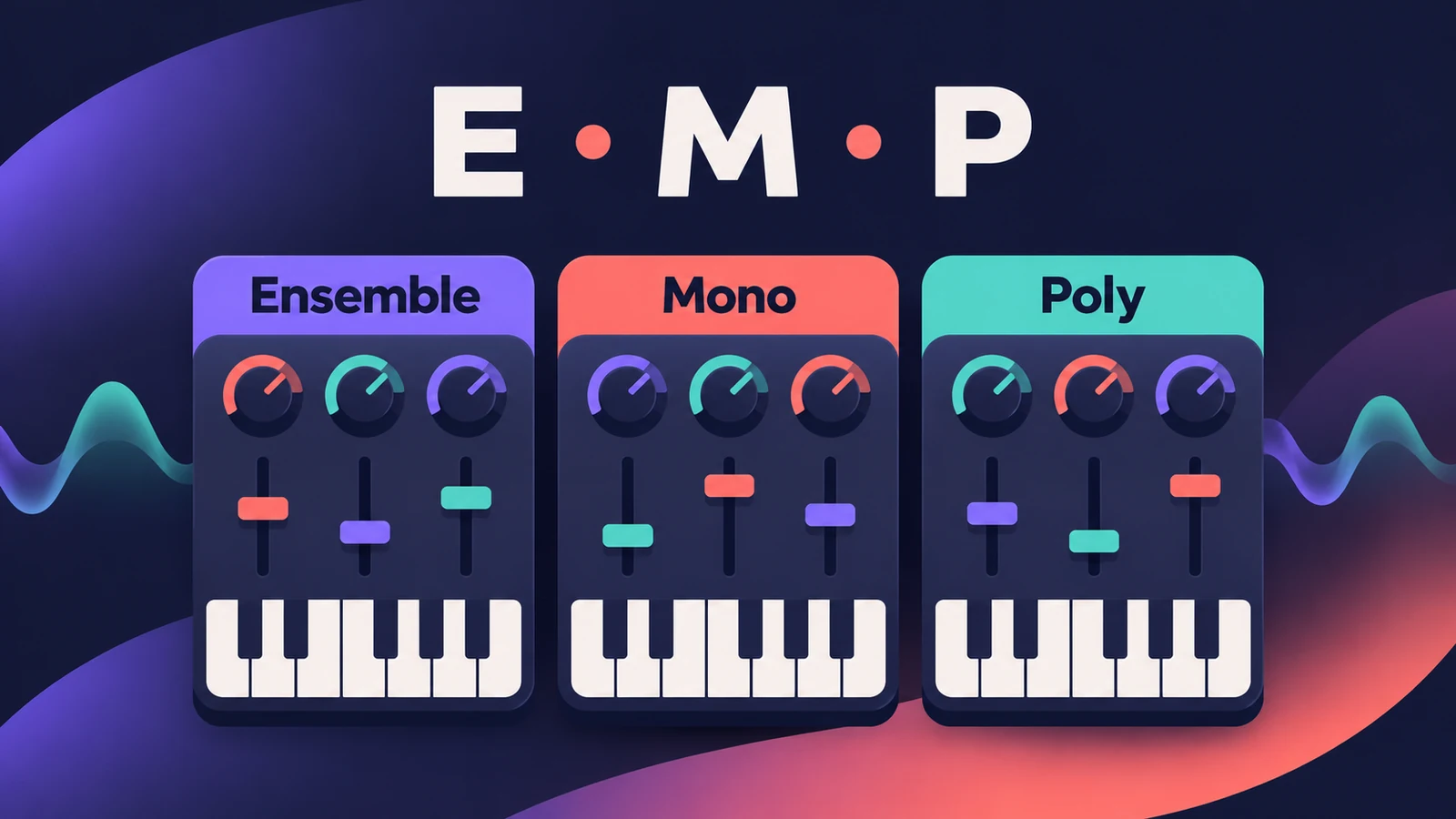
Apple lists ES E, ES M and ES P among Logic Pro's simple synthesizers. The "E" goes back to Emagic, the company that developed Logic before Apple. They're quick to program and light on processing power — handy for supporting parts in a big project.
 Owen Hartley
Which one to use
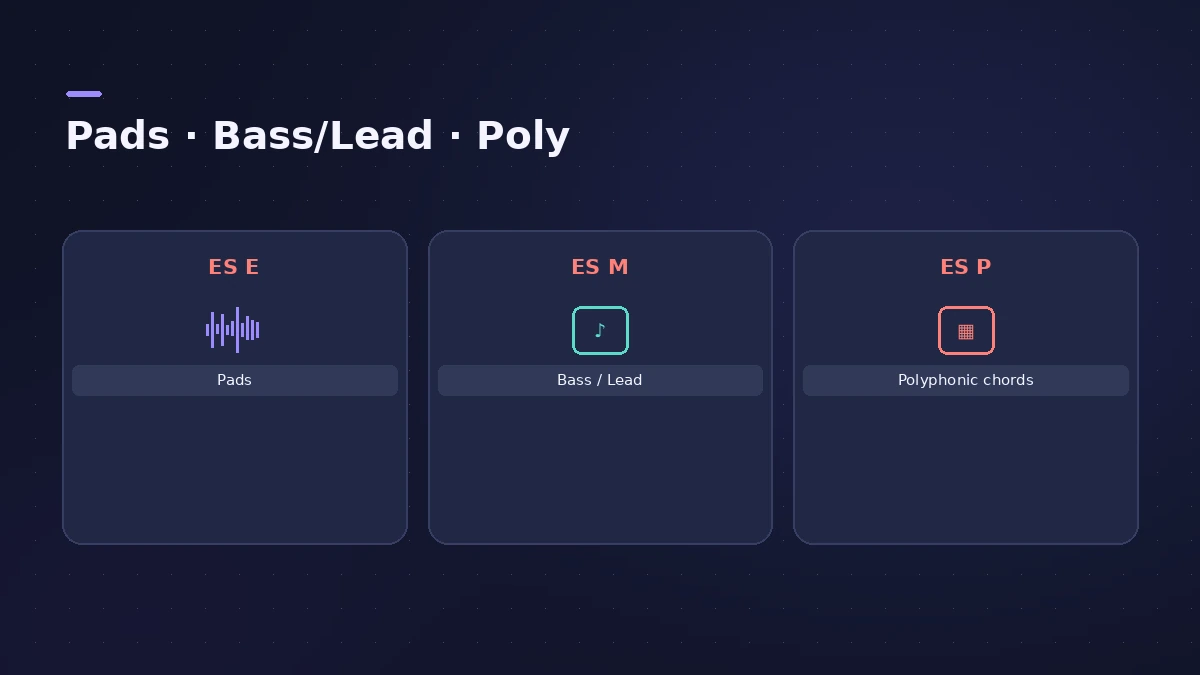
| Synth | Voices | Best for |
|---|---|---|
| ES E (Ensemble) | Eight-voice polyphonic | Warm pads, analog-style brass and strings |
| ES M (Mono) | Monophonic | Bass and lead lines |
| ES P (Poly) | Eight-voice polyphonic | 1980s-style poly sounds — pads, bass, brass |
ES P in brief
Berklee describes ES P as a subtractive synth with six oscillator sources mixed individually, an LFO, a low-pass filter and an ADSR envelope. MusicRadar lists level sliders for triangle, sawtooth, square, two pulse waves and noise.
When to move up
For more modulation and sound design, step up to ES1, ES2 or Retro Synth. For FM sounds, use EFM1.
Sources
- Apple — Logic Pro Instruments User Guide (PDF)
- Apple — Logic Pro for iPad User Guide 1.1: ES M
- Berklee Library — ES P: Exploring Logic's E-Synths
- MusicRadar — Logic Pro's E synths
- Logic Studio Training — Synthesizer cheat sheet
Checked November 2026. Logic ProFiles is independent of Apple; menu names can differ slightly between Logic Pro versions.
Frequently asked questions
Which ES synth is best for bass?
+
ES M. Apple's iPad guide calls it a good starting point for bass sounds that punch through a mix.
Are ES E, ES M and ES P worth using?
+
For pads, basses and supporting parts, yes — Logic Studio Training notes they use less processing power and are easier to program than ES1 or ES2.
Related
- ES1 in Logic ProLearn Logic Pro's ES1 synth: oscillator and sub-oscillator, filter, envelopes, glide and LFO — a simple subtractive synth for analog basses, leads and plucks.
- ES2 in Logic ProHow ES2 works in Logic Pro: three oscillators with 100 Digiwaves, FM, sync and ring mod, the Oscillator Mix pad, 10 Mod Matrix slots and the Vector Envelope.
- Retro Synth in Logic ProRetro Synth in Logic Pro explained: a 16-voice synth with Analog, Sync, wavetable and FM engines, which engine to pick for leads, pads, basses and bells.
- EFM1 FM synth in Logic ProProgram Logic Pro's EFM1 FM synth: set the carrier and modulator ratio, shape FM depth with its envelope, and get bells, electric pianos and punchy basses.
- Instruments in Logic ProGuides to Logic Pro's instruments: Session Players, Drummer, Synth Players, Chord ID, Drum Machine Designer, Sampler, Step Sequencer and Play Surface.