Gear
Dynamic or condenser: choosing a mic for Logic Pro
For home recording the room often decides. Condensers capture more detail — including your room's reflections and noise — while passive dynamics focus on the source and need no power.
 Owen Hartley

Quick comparison
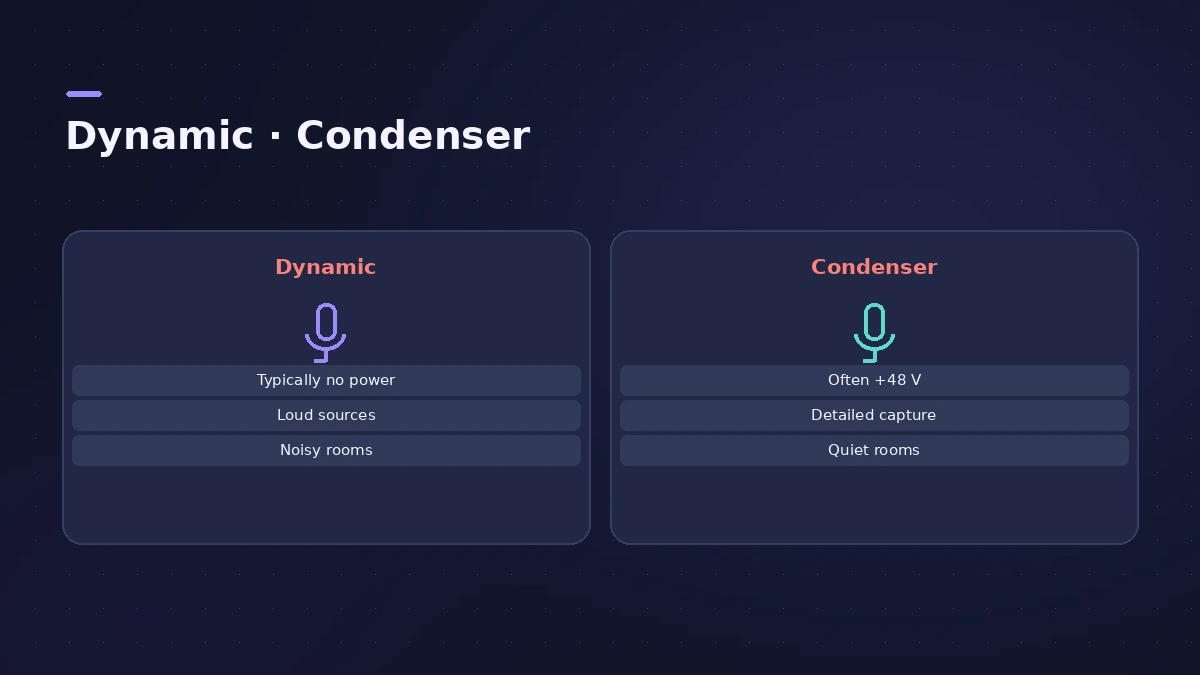
| Dynamic | Condenser | |
|---|---|---|
| Power | None for passive models | Usually 48V phantom (XLR) or USB |
| Good for | Live vocals, guitar amps, drums, noisy rooms | Studio vocals, acoustic guitar, piano, voiceover |
| Gain needed | May need more preamp gain | Less |
USB or XLR?
A USB mic plugs straight into the Mac — see USB microphone. An XLR mic needs an audio interface with enough gain and, for condensers, a +48V switch. Then follow record vocals.
Sources
- Thomann — Condenser vs dynamic microphones
- Orphiq — Condenser vs dynamic microphone: your room decides
Checked November 2026. Logic ProFiles is independent of Apple; menu names can differ slightly between Logic Pro versions.
Frequently asked questions
Do condenser mics need phantom power?
+
Most XLR condensers need 48V phantom power from an interface, preamp or mixer; USB condensers are powered over USB.
Is a condenser always better for vocals?
+
No. In an untreated room a condenser also picks up reflections and noise, so a dynamic can be the better choice.
Related
- How to use a USB microphone in Logic ProSet up a USB microphone in Logic Pro: choose it as the input device, pick the output for headphones, arm a mono track, set gain on the mic and use two USB mics.
- How to record vocals in Logic ProRecord vocals in Logic Pro: set up the mic and pop filter, arm an audio track, set the level, monitor without delay and record several takes to comp later.
- Choosing an audio interface for Logic ProWhat to look for in an audio interface for Logic Pro: class-compliant drivers, enough inputs, phantom power for condenser mics, direct ports and latency.
- Acoustic treatment for a home studioTreat a small room for mixing in Logic Pro: bass traps in the corners first, absorbers at first reflection points via the mirror trick, then a ceiling cloud.
- Gear for Logic ProGear for Logic Pro in 2026: which Mac or MacBook to buy, how much RAM you need, moving the Sound Library to an SSD, control surfaces, Logic Remote and Sidecar.