Gear
Acoustic treatment for a home studio
Treatment makes what you hear in your room closer to what's in the mix. In a small room the usual order is corners first for bass, then the first reflection points.
 Owen Hartley
Where to find it
Corners, side walls and ceiling
Order of work
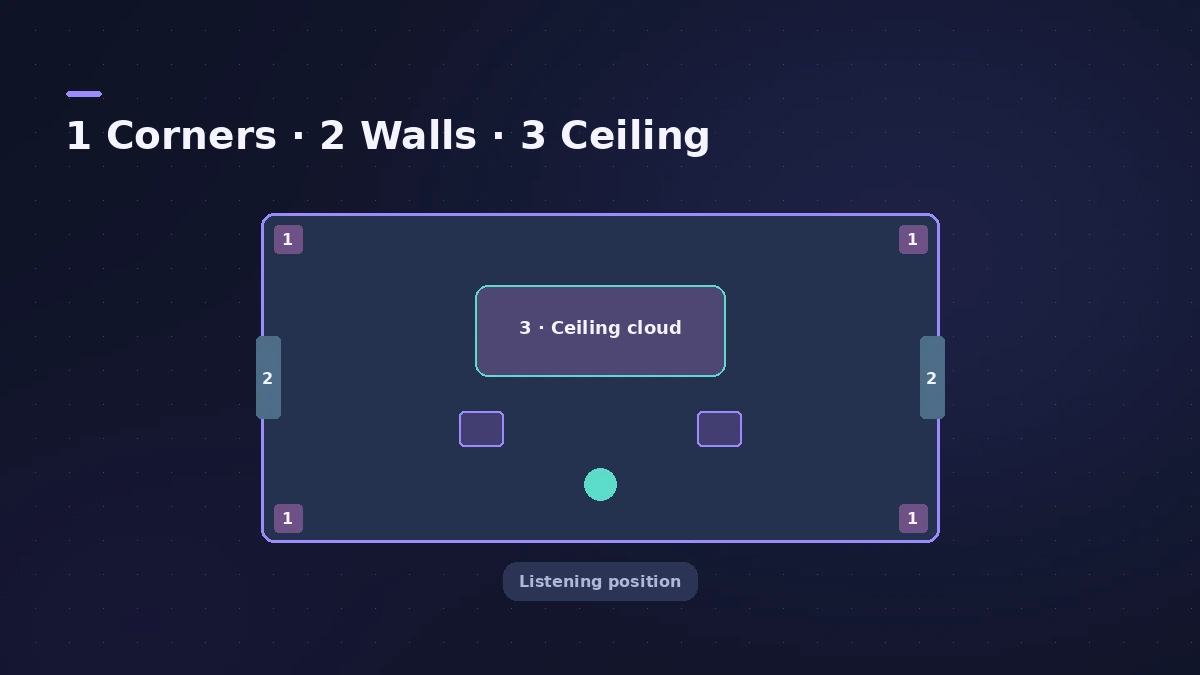
| Step | Treatment | Where |
|---|---|---|
| 1 | Bass traps | Room corners |
| 2 | Absorption panels | Side-wall first reflection points |
| 3 | Ceiling cloud | Above the mix position |
Step by step
-
1
Place your monitors first
Set up the listening triangle before treating, because the mirror trick depends on where the speakers and your head are.
-
2
Trap the corners
Put bass traps in the corners first — floor to ceiling if you can.
-
3
Find first reflections
Sit in the mix position while a friend slides a mirror along each side wall. Wherever you see a speaker in the mirror is a reflection point.
-
4
Treat those points
Place absorption panels at the reflection points you marked.
-
5
Add a ceiling cloud
Once corners and side walls are covered, treat the ceiling above the mix position.
Common mistakes
- Starting with the walls: Auralex puts bass traps in the corners as the first step in a small room.
- Stopping at the minimum: Corners and side reflection points are the essential first steps, not the whole job.
Work out your bass problems
Use the room mode calculator to see which bass notes your room's dimensions reinforce.
Sources
- Auralex — Basics of treating a home studio
- OWC — Understanding basic acoustics in your home studio, part II
- Sonarworks — How to set up your studio for better mixes
- Sound On Sound — Studio SOS guide to monitoring and acoustic treatment
Checked November 2026. Logic ProFiles is independent of Apple; menu names can differ slightly between Logic Pro versions.
Frequently asked questions
What should I treat first in a home studio?
+
Corners with bass traps, then the first reflection points found with the mirror trick.
How bad can corner bass build-up be?
+
Sonarworks says bass pressure in small-room corners can cause variations as large as 30 dB.
Related
- Place your studio monitors for mixingSet up studio monitors for mixing in Logic Pro: equilateral triangle, about 30° toe-in, tweeters at ear height, symmetrical in the room and off the desk.
- Room mode calculatorEnter your room's length, width and height to find axial room modes — the bass frequencies that boom or vanish at your mix position — in metres or feet.
- Dynamic or condenser: choosing a mic for Logic ProDynamic or condenser for home recording in Logic Pro: which suits vocals, guitar amps and untreated rooms, what phantom power is, and USB vs XLR microphones.
- Gear for Logic ProGear for Logic Pro in 2026: which Mac or MacBook to buy, how much RAM you need, moving the Sound Library to an SSD, control surfaces, Logic Remote and Sidecar.